£0.00 0 items
Human givens therapy: a close-up on how it works

Denise Winn: journalist, editor, therapist and author.
I had a new client yesterday, who complained of bad depression. He couldn’t sleep and had no interest in anything any more.
“When did it start?” I asked.
“Oh, I’ve always had it,” said Michael, with a helpless shrug.
“Really?” I said. “Then what is it that is making you seek help now?”
Michael was surprised by the question. “I suppose because it’s worse now than it has ever been before,” he finally offered.
“So has something happened recently, then, that has made the depression so bad” I asked him gently.
And then it all came out. His girlfriend of four years had left him for another man, with whom it turned out she had been having an affair. Jeanette, he told me, had been his whole reason for living. “She found it hard to trust when we first met, because she had been so let down before. I said I would never do that to her. I had had all these ‘projects’ going – like teaching kids how to maintain their own bikes and doing pharmacy runs for disabled people – but I gladly gave all that up because she became my project, keeping her happy, making her feel safe and special. Now nothing will ever matter to me again!” He started quietly to cry.
So, all at once, he had lost his sense of security, control, intimate connection, status, and meaning and purpose, and was catastrophising an unbearable future. Now I knew where to direct the therapy.
Only when essential emotional needs are met, and our innate resources are used correctly, will we be mentally healthy.”
Essential needs
Developed over 30 years ago, the human givens therapeutic approach derives from the understanding that it is not just physical needs, such as for air, food, water and shelter, that are vital for our health and wellbeing. Only when essential emotional needs are also met, and the innate mental resources we have to help us meet them are used correctly, will we be emotionally and mentally healthy.¹
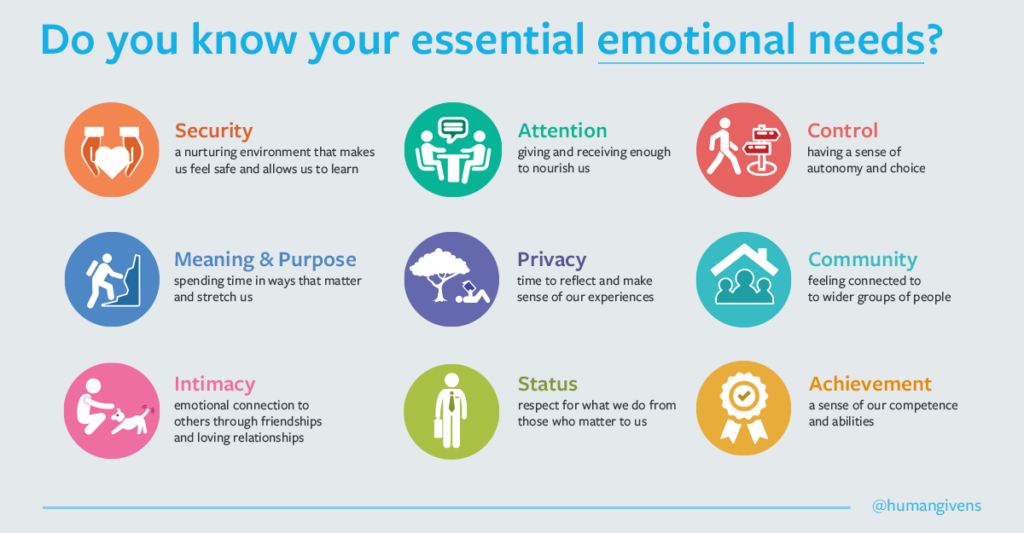
Essential emotional needs, identified over decades by health and social psychologists, include those that I mentioned above. I’ll unpack them a bit more fully.
 |
Sense of security Deep insecurity about anything, such as finances, our career or our future, or feeling physically or emotionally unsafe in a relationship, at work, in our neighbourhood, etc, inevitably impacts negatively on our wellbeing. |
 |
Close to that is the need for a sense of control. It may be that we are in an unhealthily controlling relationship. Or we don’t feel we have any say over how we do our work. Or someone else controls our finances. We need to feel that we have some choices, even though we can’t control all outcomes in life. |
 |
Attention We have a need to give and receive it. But it needs to be in proportion. Sometimes we may spend too much time with someone who saps our energy because of their own attention needs. Or we engage in certain activities, just to get attention. |
 |
Emotional connection Neuroscience shows that we are social animals, even at the level of our brains. We need to feel connected to others to stay physically and mentally healthy, and have at least one person we can feel fully ourselves with and fully accepted by – an intimate connection, although that doesn’t have to mean a sexual one. And we need wider connections as well, to be fully healthy. That means being involved in activities with others, whether family activities or sports or drama or religious worship or in a community activity of some kind. |
 |
Achievement and competence It is vital to feel that we are good at certain things, whatever they are. |
 |
Linked to that is a sense of status. By that we mean feeling respected and appreciated for some of the things that we do, and care about. It could be about being good at our job. But it could also be about always being there to help when a friend is in trouble, organising the under-12s Sunday football club, knowing what to do in a crisis or for being good fun to be around. In other words, we need to feel valued for something that we do. |
 |
Privacy We need sufficient time and mental space for ourselves when we can calmly reflect on and process our experiences. Otherwise we can become overwhelmed. |
 |
And, last but very far from least, we need a sense of meaning and purpose, something that gets us up in the morning. People find this in different ways – for instance by feeling needed by people we care about or as a member of a team or by a pet or even a plant; challenging ourselves to learn new things; or having a commitment to something bigger than ourselves, such as a religion or belief system, community or political movement. |
Sometimes, however, we may get these needs met unhealthily (for instance, young people may get their need for attention met by being members of a violent gang) or someone may meet their own need for control at the expense of others. And sometimes we don’t get our needs sufficiently well met at all.
Vital psychological resources
The innate psychological resources that we are gifted by nature to help us meet these needs include our abilities to learn from experience, plan, judge, remember things, imagine, relate one thing to another, empathise, develop a moral sense, etc.
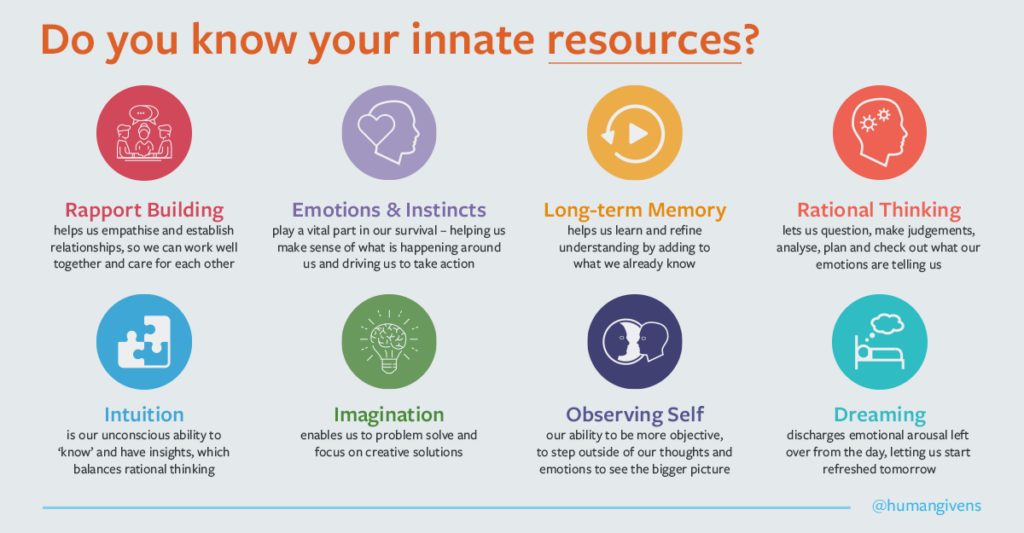
According to human givens understandings, it is when emotional needs are not adequately met or met in unhealthy ways, or when innate resources are damaged for any reason or unintentionally misused, that conditions such as anxiety, anger, depression, addiction and even psychosis can develop. For instance, misuse of the imagination – to conjure up worst possible or threatening scenarios – is a feature common to these states.
Symptoms are only a guide
This knowledge gives me the framework from within which I work as a human givens therapist. When someone like Michael comes to me with depression, for instance, I don’t focus on the depression and the misery; I look to identify what is missing in his life and which innate resources are being misused, and together we address ways to remedy that. The symptoms of depression are important as guides but it is the changing of perspective, learning of coping skills and making specific life changes that will shift the depression.
So I needed Michael to see that he was misusing his imagination to tell himself that his life would never be meaningful again. I gave him empowering psychoeducation to explain why he wasn’t able to sleep (this comes from human givens understandings about why we dream and the connection with depression).²
We looked at his tendency towards all-or-nothing thinking — that everything had been perfect with his girlfriend and he was completely lost without her. We also addressed his tunnel vision — clearly what had seemed perfect to him had not seemed perfect to her, and he began to realise that he had put her on a pedestal, stifling her, relying on her even more heavily than he was inviting her to rely on him. He had so arranged his life that all his needs were being fulfilled through her.
I don’t focus on the depression and the misery; I look to identify what is missing in his life.’’
Over three sessions, we worked on helping him identify other ways to meet his social needs. He enjoyed his job in banking (although depression tunnel vision had led him to dismiss that) and fortunately, he already had experience of enjoying voluntary work. He decided to start up his bike repair workshops again, and also join a local litter pick and a local choir, which would help him meet new people in his neighbourhood.
A very important tool in the human givens armoury is guided imagery – we relax clients deeply and guide them to rehearse or try out their new skills or intentions in their imagination (for instance, going for a walk via a specific route or holding a conversation successfully with someone new) within the safety of the therapy room, applying techniques they have been taught, such as deep breathing or cognitive techniques, to handle any setbacks. This instils a sense of optimism and growing confidence. We use metaphors and stories, as I did with Michael, to convey the message that he could put his life together again, with more self-understanding and, therefore, with greater control.
Importantly, Michael was able to realise that depression, far from being an ‘illness’ he had suffered from all his life, was merely something that had descended on him at different times, when things weren’t working out for him. We were able to identify that the first time he had suffered from depression was when his parents started arguing violently in the house, eventually divorcing when he was eight. Depression reappeared when he struggled with the transition to secondary school and then when he went to university and was badly hurt by another girlfriend. She had been a free spirit so, in retrospect, he could see why he had been so attracted to Jeanette, whom he saw as damaged and delicate and needy.
As the home situation with his parents and the pain experienced with the two girlfriends still caused him physical anxiety when he thought about them, I decided to use the rewind detraumatisation technique, a refined version of which was developed by the human givens co-founders, psychotherapists Joe Griffin and Ivan Tyrrell. Carried out in a state of deep relaxation, it enables the high emotional arousal to be detached from the memory so that the painful experiences can be recognised as in the past.³
 I like to term what Michael learned as skills for life – so he can recognise what is happening if depression descends again, address what is not working and get back on track. These skills include better self-knowledge, techniques for handling unhelpful thinking and the understanding that needs will not be met by staying at home, engulfed by misery, but by getting out there, however reluctantly, and starting to do the things that will turn the depression around.
Human givens is a powerful, very often speedy, respectful approach to mental health matters. When we look at life from its perspective, we can see that troublesome states, like depression, like hostility, like excess anxiety or anger, reflect the fact not that there is something deeply wrong with our clients but that something– or some things – aren’t working for them in their lives, and we can investigate and remedy that together. It is infinitely satisfying and can be studied as part of the Human Givens Diploma or in standalone trainings.
References
1. What’s different about the human givens approach to therapy. https://www.hgi.org.uk/about-hg/how-is-hg-different-from-other-therapy-approaches; Griffin, J and Tyrrell, I (2024) Human givens: an empowering approach to emotional health and clear thinking. East Sussex: HG Publishing.
2. Griffin, J and Tyrrell, I (2004) How to lift depression … fast. East Sussex: HG Publishing.
3. The rewind technique. Available at https://www.hgi.org.uk/discover/mental-health/the-rewind-detraumatisation-technique/