£0.00 0 items
What are the human ‘givens’?
Every single one of us is born with essential physical and emotional needs and, if we are born healthy, the innate resources to help us fulfil them. These innate needs have evolved over millions of years and are our common biological inheritance, whatever our circumstances or cultural background.
It is because these important needs and resources are incorporated into our very biology that they became known as human ‘givens’ – if these innate needs aren’t being met well enough in our lives we are vulnerable to mental health and behavioural problems.
Our innate needs seek their fulfilment through the way we interact with the environment using the resources nature ‘gave’ us. But when our emotional needs are not being met, or we are using our resources incorrectly, we suffer considerable distress. And so can those around us.
In everyday terms, it is by meeting our physical and emotional needs that we survive and develop as individuals and a species. As animals we are born into a material world where we need air to breathe, water, nutritious food, physical connection and sufficient sleep. These are the paramount physical needs. Without them, we quickly die.
We also need the freedom to stimulate our senses and exercise our muscles. In addition, we instinctively seek sufficient and secure shelter where we can grow and reproduce ourselves and bring up our young. These physical needs are intimately bound up with our emotional needs — the main focus of human givens psychology, and the basis of Emotional Needs and Resources Theory.
There is widespread agreement about the nature of our psychological or emotional needs, uncovered by decades of health and social psychology research. The main ones essential for our mental health are listed below.
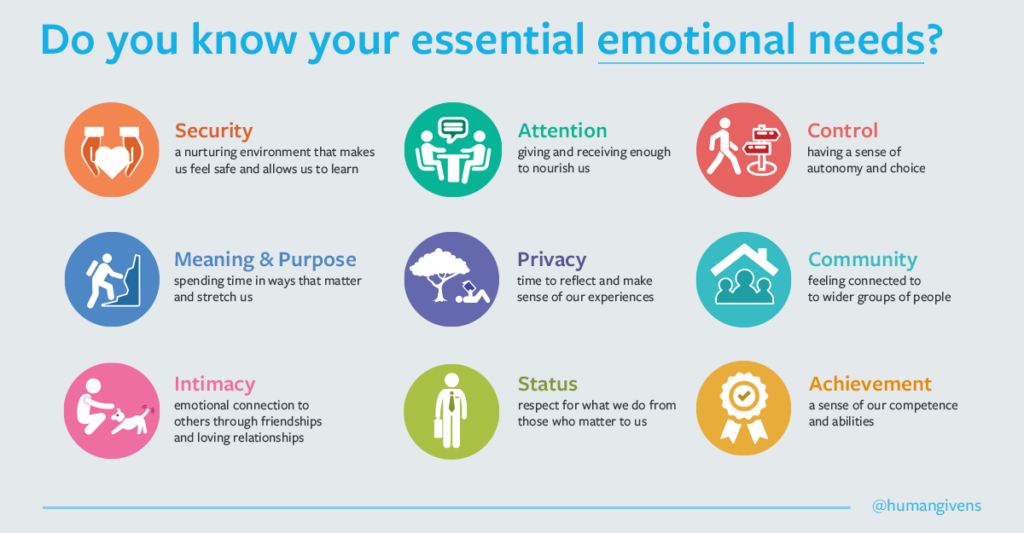
Our 9 essential emotional needs are:
 |
Security A safe environment that allows us to live without fear, develop fully and have space to grow |
 |
Attention (to give and receive it) Giving and receiving it are both vital forms of nutrition that fuel our development |
 |
Control A sense of having some control over what happens to us and around us, the freedom to make our own decisions and choices |
 |
Meaning and purpose This can come from being stretched, mentally or physically, being helpful in our communities, or being connected to ideas or beliefs greater than ourselves |
 |
Privacy Enough time and space to reflect on, learn from and consolidate our experiences |
 |
Community Connection to other people outside our immediate family, through work, hobbies, sport, geographical or cultural communities |
 |
Emotional intimacy Emotional connection to others through friendships and loving relationships |
 |
Status A sense that we are accepted, valued and respected for who we are and what we do by those who matter to us |
 |
Achievement and competence A sense of our own competence and abilities, knowledge and skills |
Along with physical and psychological needs nature gave us ‘internal guidance systems’ to help us meet them – we call these ‘resources’. How we develop and use our resources is just as important as getting our innate needs met.
 |
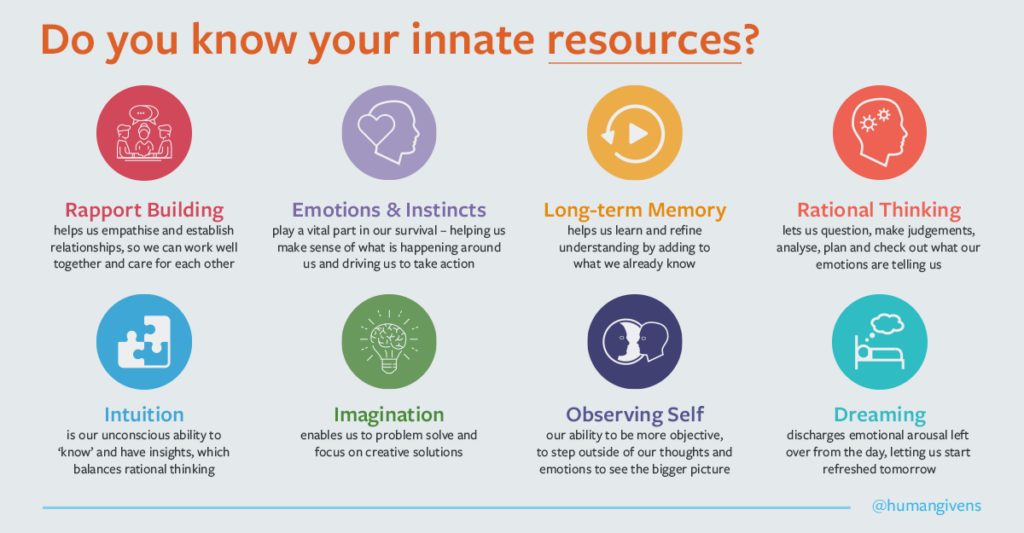
Rapport Building The ability to build rapport, empathise and connect with others. |
 |
Emotions and instincts A guidance system whereby, through the release of a variety of neurotransmitters, hormones and other chemical messengers, we are driven to act to meet our survival needs. |
 |
Long-term memory The ability to develop complex long-term memory, which enables us to add to our innate knowledge and learn. |
 |
Rational Thinking The conscious, rational ability to check out emotions, question, analyse and plan. |
 |
Intuition The ability to ‘know’ — that is, understand the world unconsciously through metaphorical pattern matching. |
 |
Imagination Enables us to focus our attention away from our emotions, use language, and problem-solve more creatively and objectively. |
 |
Observing self That part of us that can step back, be more objective and be aware of itself as a unique centre of awareness, apart from intellect, emotion and conditioning. |
 |
Dreaming Dreaming is our brain’s way of preserving our instincts and defusing unresolved or unfulfilled emotional arousals (including worries and ruminations) to create spare mental capacity for the next day. |
As we mentioned above, it is such needs and tools [resources] that, together, make up the human givens: nature’s genetic endowment to humanity.
Over enormous stretches of time, our needs and resources underwent continuous refinement as they drove our evolution on. They are best thought of as inbuilt patterns — biological templates — that continually interact with one another and (in undamaged people) seek their natural fulfilment in the world in ways that allow us to survive, live together as many-faceted individuals in a great variety of different social groupings, and flourish.
It is the way these needs are met, and the way we use the resources that nature has given us, that determine the physical, mental and moral health of an individual.
When too many innate physical and emotional needs are not being met in an environment, or when our resources are used incorrectly, unwittingly or otherwise, we suffer considerable distress
Thus, the human givens should be a benchmark to which we all refer — in education, mental and physical health and the way we organise and run our lives.
When we feel emotionally fulfilled and are operating effectively within society, we are more likely to be mentally healthy and stable. But when too many innate physical and emotional needs are not being met, or not being met sufficiently well enough, or when our resources are used incorrectly, unwittingly or otherwise, we suffer considerable distress. And so do those around us.
The human givens framework, therefore, offers a revolutionary organising idea, one which is derived from scientific understandings from neurobiology, psychology, ancient wisdom and original new insights.
Disseminated and taught predominantly in the UK for over 20 years, and initially focused on the treatment of mental distress, this still relatively new school of psychology has been recognised by many as a profoundly important shift in our understanding of human functioning. It has been called “the missing heart of positive psychology”.
The startling success produced by the efficacy, adaptability and practical nature of these new ideas, is borne out by the speed at which the human givens model is moving into new areas, ranging from psychotherapy, education and social work to international diplomatic relations and the corporate world of business.
Having our innate emotional needs met in balance is best regarded as a form of nutrition, not too little, not too much, just as a balanced diet of healthy food nourishes our body, but too much, too little or the wrong type is bad for us
Ivan Tyrrell